
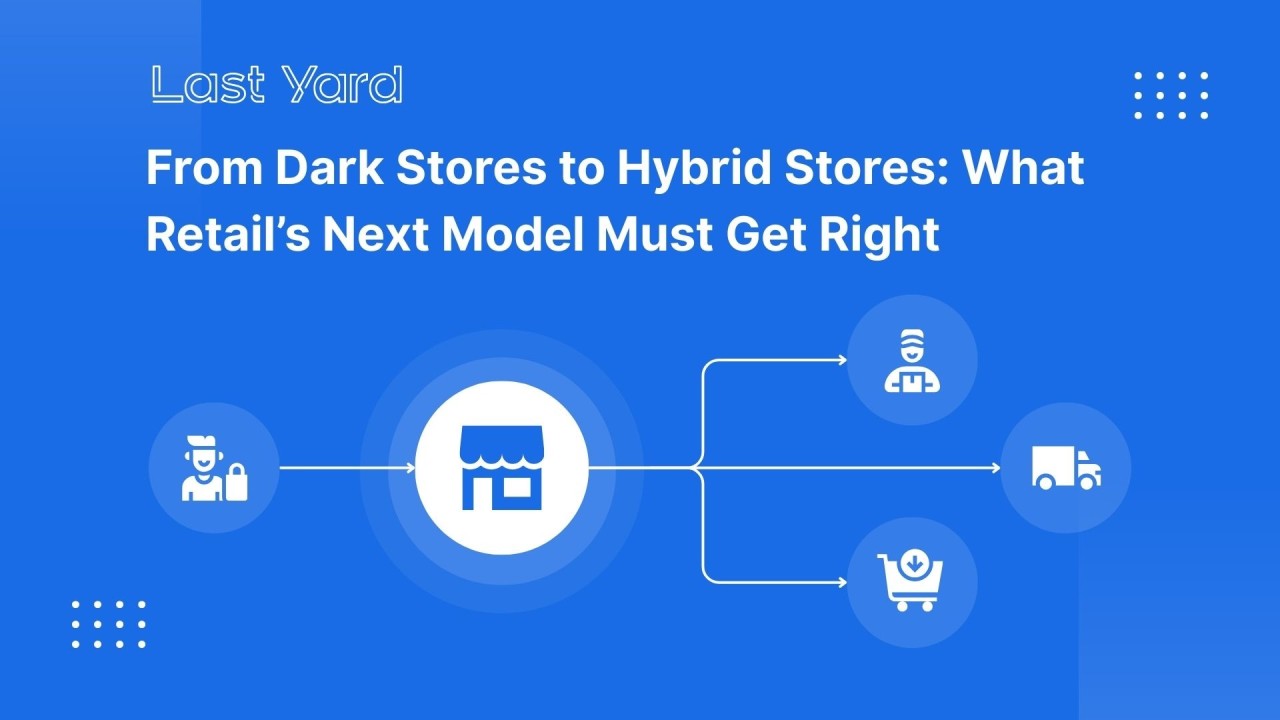
Over the past decade, retailers have experimented with new formats to keep pace with shifting consumer behaviour. Few innovations generated as much excitement as the dark store, where locations are converted exclusively for online fulfilment.
The model promised efficiency: dedicated picking, fast dispatch, and no interference from in-store customers. Forecasts still paint a bullish picture, with the global dark store market projected to grow from US$30 billion in 2025 to nearly US$300 billion by 2032.
But reality proved more complicated. Dark stores inherited the same fixed costs as traditional stores — prime rents, labour, utilities, but without the offset of walk-in traffic or incremental basket sales. Meanwhile, last-mile delivery remained stubbornly expensive, accounting for up to 53% of total supply chain costs.
In dense urban centres with predictable volume, dark stores can work. But as a universal model, they have not been the silver bullet many expected.
The Hybrid Store Reality
With dark stores failing to scale everywhere, attention has shifted back to the traditional store. The difference is that stores today are no longer just retail showrooms. They have become hybrid environments: serving in-person shoppers while doubling as fulfilment hubs for online orders.
This shift is visible across markets. In some regions, 20–30% of sales are now fulfilled directly from stores, picked off the shelves, and sent out through scooters, couriers, or click-and-collect. It’s a pragmatic solution, leveraging existing networks. But it also places new pressures on stores that were never designed for dual roles.
Staff are pulled between customer service and order picking. Aisles become congested with both shoppers and staged baskets. Promotions that run online don’t always match what’s displayed on the shelf, creating confusion and eroding trust. And all the while, rents and rates — priced for pure retail — are stretched to justify this new hybrid reality.
Hybrid stores are not a passing phase. They are the frontline of omnichannel retail. But to make them sustainable, something has to change.
What Retail’s Next Model Must Get Right
The lesson from dark stores is clear: space alone doesn’t solve fulfillment challenges. The lesson from hybrid stores is equally important: without the right foundations, dual-purpose formats risk becoming cost sinks instead of growth drivers.
What retailers need are a few core capabilities that make the model work:
- Consistency across channels: ensuring that the promotions and prices customers see online are the same ones reflected in-store, protecting both margin and trust.
- Reduced manual effort: automating signage and updates so staff spend less time fixing errors and more time serving customers or fulfilling orders accurately.
- System integration: connecting POS, inventory, fulfilment, displays, and online platforms so the store can operate seamlessly as both a retail environment and a logistics node.
- Scalable efficiency: allowing retailers to process higher fulfilment volumes without expanding headcount in lockstep.
In short, these aren’t nice-to-haves. They’re what allow the hybrid model to scale sustainably.
Looking Ahead
The real debate isn’t dark stores versus traditional stores. It’s about how to make the stores we already have fit for dual purpose. That requires deliberate choices about which stores are best suited for fulfilment, investment in automation that keeps digital and physical channels synchronised, and a shift in performance metrics. Sales per square metre will remain important, but hybrid stores also need to be measured by fulfilment accuracy, signage consistency, and the quality of the customer experience.
Retailers that succeed in this environment won’t necessarily be the ones with the biggest footprints or the most ambitious technology pilots. They’ll be the ones that master the details: keeping prices and promotions aligned, reducing errors, and ensuring that what customers see online is precisely what they find in-store. In the hybrid era, execution isn’t a back-office function; it’s the frontline of customer trust, loyalty, and growth.

About the author
Serene Tan
Serene is a strategic marketer at Last Yard, leading marketing across multiple markets with a focus on go-to-market strategy, brand positioning, and integrated campaigns that build awareness and drive growth. With deep expertise in B2B buying journeys, she combines creative storytelling with operational execution to deliver results across long sales cycles.